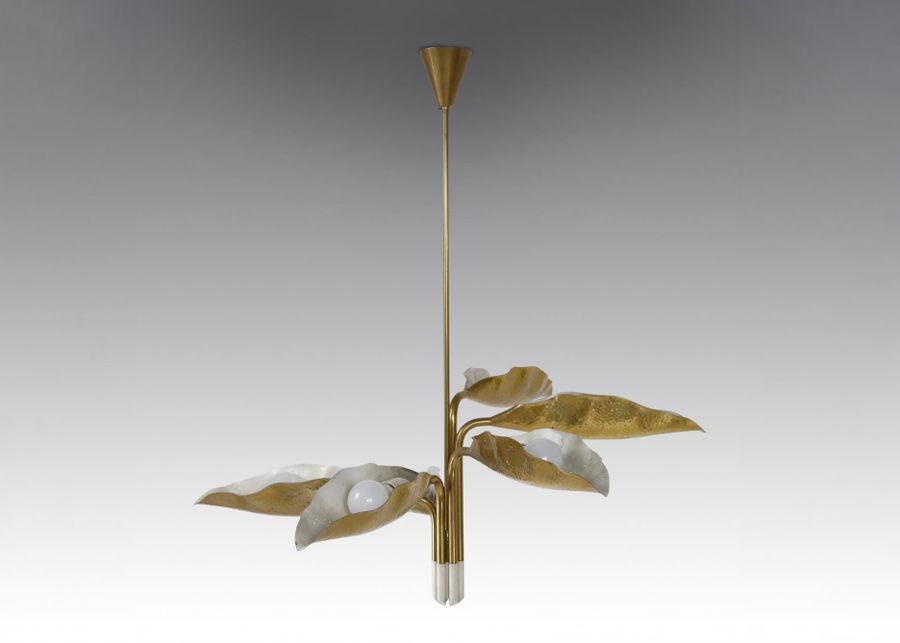
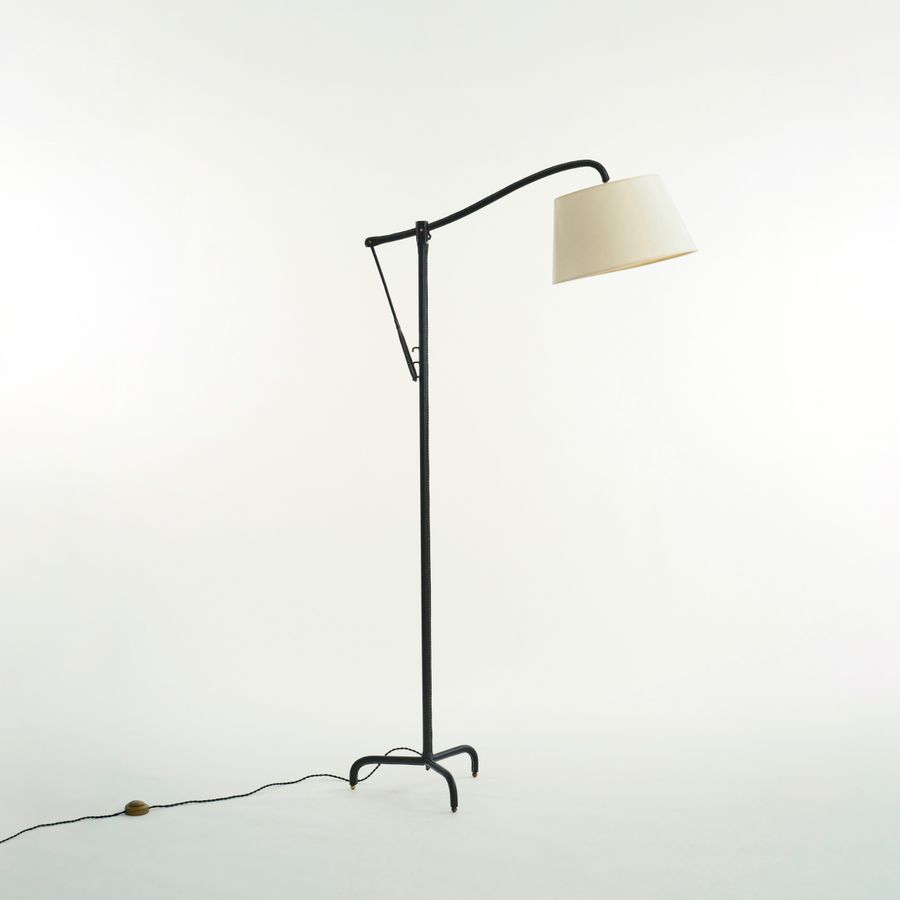
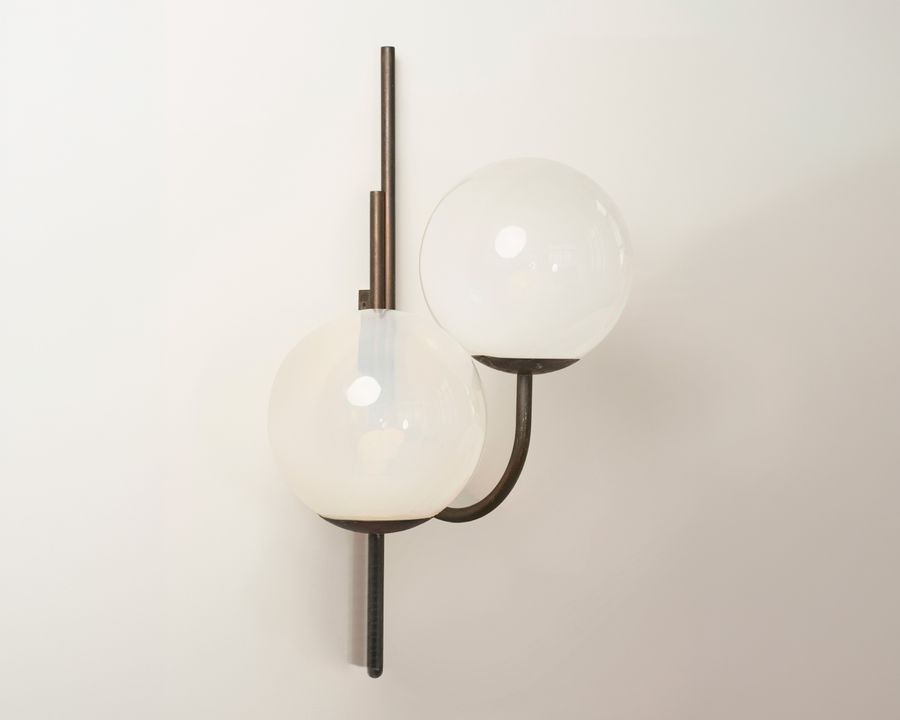
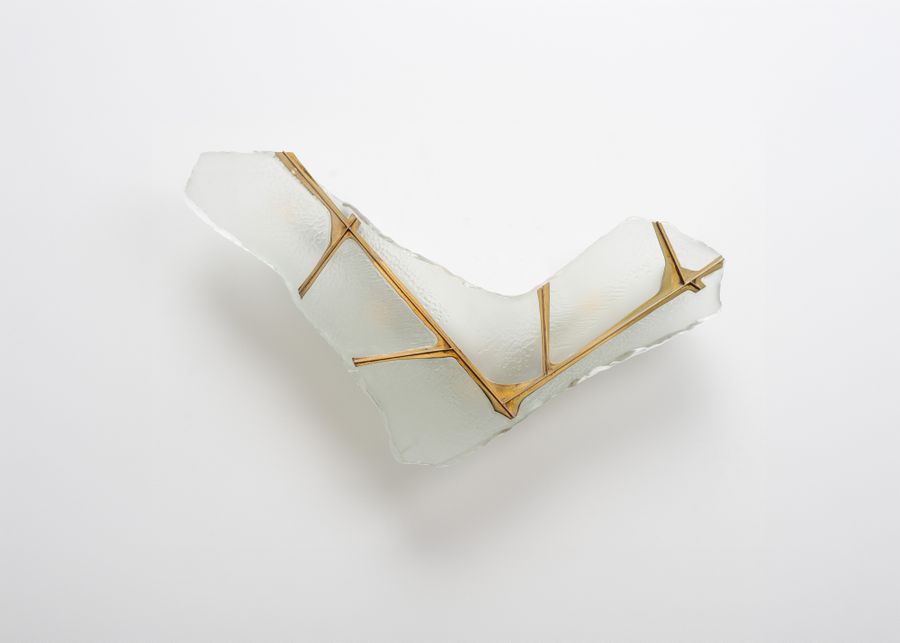
"Ondulation" Six-Light Chandelier
Jean Royère
:quality(90))
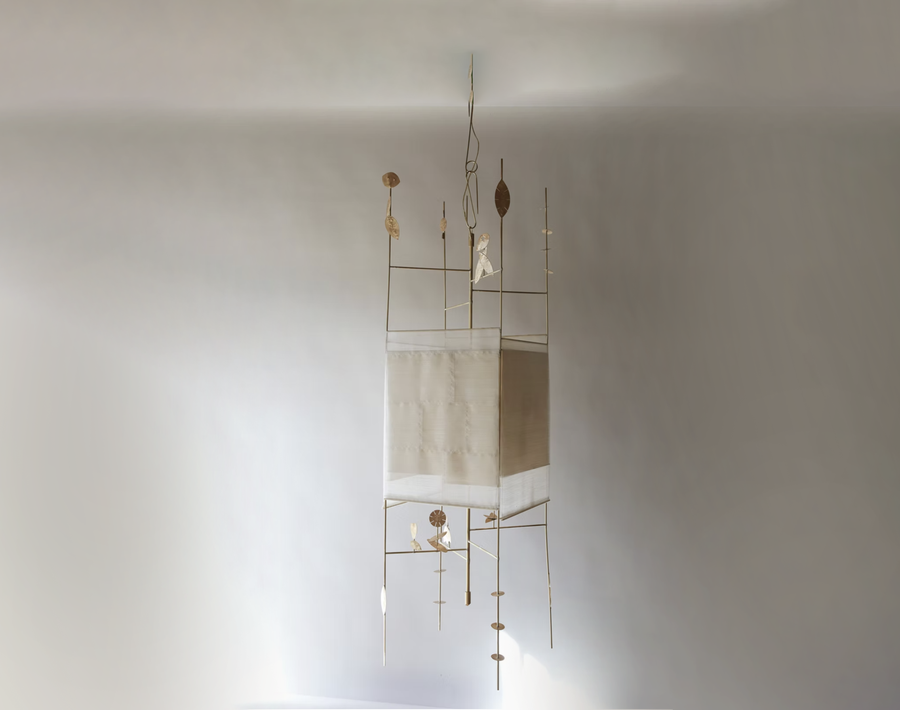
Six lights chandelier in wrought iron with its original gilt patina. New lampshades made on the original model.
This model, rare on the market, exists in several colors. The one exhibited by the gallery has kept its original gilt patina.
This chandelier was commissioned by the first collector in 1948.
Jean Royère
After working for several years in the bank and the export area, Jean Royère chooses to embrace a belatedly career of decorator. It is from 1931 that Royère begins to familiarize with furniture trades, faubourg Saint-Antoine in Paris, France. Very quickly, Jean Royère wins competitions and prizes and gets known in the world of decorators and Parisian clientele.
In 1934 Royère meets Pierre Gouffé who commits him for the realization of set ups and modern furniture. Sure of his talent, Gouffé incites the young decorator to exhibit in 1934 at the ‘Salon d’Automne’ and in 1935 at the ‘Salon des Artistes Décorateurs’. At the time, he is one of the most original and most creative decorators of moment.
In 1942 Royère opens his first gallery at rue d’Argenson, 5 and begins to get bigger just after the war beyond the borders: in Egypt (1946), in the Lebanon (1947), then in Syria, in Jordan, in Saudi Arabia, in Iraq and in Iran. He realizes hudge construction sites such as Tehran senate (19581960), in Iran. From 1953 Jean Royère also shoots to South America, and opens offices in Peru and in Brazil.
But it’s in Paris where Royère concentrates his activity. From 1949, he settles a new gallery, wider, at rue Faubourg Saint-Honoré, 182 in which he will stay until the early 1970’s. American resident since 1972, Royère leaves France in 1980 after having put on public sale public is personal furniture, an overview offorty years of creation. He dies one year later in Pennsylvania.
At the beginning of his career, Jean Royère is influenced by the famous decorators of the 1930’s such as Emile-Jacques Ruhlmann, but also by modern artists such as Djo Bourgeois. Self-taught man, Royère evolves between 1933 and 1939 towards a style of his own, original and ingenious, “not connected with any school” he says himself. A single principle: the perfection in the harmony of the result. Full of humor, poetry, wonder but also boldness, these inovations reflect at the same time their creator’s imagination, but also the revival of the modern style.
:quality(90))
:quality(90))
:quality(90))
:quality(90))